










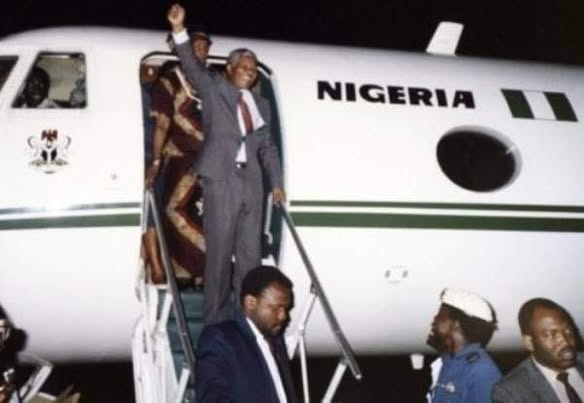
News Agency of Nigeria (NAN),
In late April, a new wave of violent anti-migrant protests erupted in South Africa, claiming lives and destroying property of African migrants.
The unhinged xenophobes marauding under the code name, Operation Dudula, are running amok in towns and cities, even schools and homes, looting foreign-owned shops, harassing and physically attacking foreign nationals.
Dudula is a Zulu word for force out or knock down.
The Dudula group has been issuing threats, warning African migrants to leave South Africa by June 30 or face the consequences.
The group consistently blames African immigrants for taking local jobs, driving up unemployment, and straining public resources.
Social media is chock-full of videos—though unverified—showing African migrants being gored, shot, trampled, and stripped naked, sometimes under the watch of law enforcement officers.
Following the latest surge in xenophobic attacks, two Nigerians–Amaramiro Emmanuel and Ekpenyong Andrew–have been killed in South Africa.
Ninikanwa Okey-Uche, Consul-General of Nigeria in Johannesburg, in a statement, said they were killed by personnel of South African National Defence Force (SANDF) in Port Elizabeth.
“On this, we are calling on South African authorities to thoroughly investigate the matter and bring the perpetrators of the gruesome act to justice.
“No one should take laws into their own hands under any circumstances. We hope to achieve the ultimate prosecution of the perpetrators,” she said.
Various African countries have reacted and invoked the necessary diplomatic measures, including the evacuation of their nationals living in South Africa.
In line with oversight of AU treaty obligations, Ghana recommended instituting a fact-finding mission to examine the root causes of xenophobia in South Africa.
While the Nigerian Government summoned South Africa’s Acting High Commissioner to Nigeria, Lesoli Machele, for urgent talks, South Africa’s Minister of International Relations and Cooperation, Ronald Lamola, pledged to work with Nigeria to ensure the safety of Nigerians.
As outrage spreads across the continent, perceptive stakeholders argue it is time to remind the Dudula group of the Mandela Tax and the Pan-African solidarity that ended the apartheid regime.
In hindsight, the Mandela Tax—a mix of compulsory salary deductions for Nigerian civil servants and voluntary citizen donations in the 1970s and 1980s—was used to support South Africa’s anti-apartheid struggle and the Southern Africa Relief Fund (SARF).
Deserving no less attention is the Pan-African solidarity spearheaded by the Organisation of African Unity (OAU), now the African Union (AU), with support from regional powers like Nigeria and Tanzania.
Through such camaraderie, African states implemented sanctions, offered training and refuge to liberation movements, and diplomatically isolated the apartheid regime, culminating in the 1994 democratic election.
Nations like Tanzania, Zambia, Angola, Mozambique, and Botswana provided direct, high-risk support to liberation fighters by hosting bases and offices.
Weighing in on the vexatious development, Amb. Akinremi Bolaji, former Director of Economic, Trade, and Investment, Ministry of Foreign Affairs, said there was a need for caution.
According to the diplomat, the question raises a sensitive but important issue that should be answered in a way that promotes dialogue, diplomacy, historical awareness, and African unity — not retaliation or hostility.
“Many African countries, especially Nigeria, made enormous sacrifices in support of South Africa’s liberation struggle.
“Nigeria contributed financially, diplomatically, politically, and morally through what many described as the “Mandela Tax,” where ordinary Nigerians voluntarily supported the anti-apartheid movement.”
He said that rather than responding with anger or division, several constructive steps could help remind younger generations of the shared history and strengthen African unity.
The former Nigeria’s High Commissioner to Singapore said that many young South Africans might not fully understand the extent of African solidarity during apartheid.
“African governments, universities, filmmakers, and media institutions should promote documentaries, school curricula, cultural exchanges, and public discussions about the anti-apartheid struggle and the role played by countries like Nigeria, Zambia, Tanzania, and others.”
The diplomat proffered student exchanges, African youth forums, AU-sponsored programmes, and cultural diplomacy which could foster direct people-to-people understanding.
Bolaji made a case for strong diplomatic engagement.
He said the governments of Nigeria and South Africa should continue bilateral dialogue on migration, business competition, labour issues, and citizen protection while avoiding inflammatory rhetoric.
At the AU level, Bolaji said that African Union institutions should more actively promote Pan-African citizenship, conflict prevention, and civic education around African brotherhood and integration under the AfCFTA vision.
