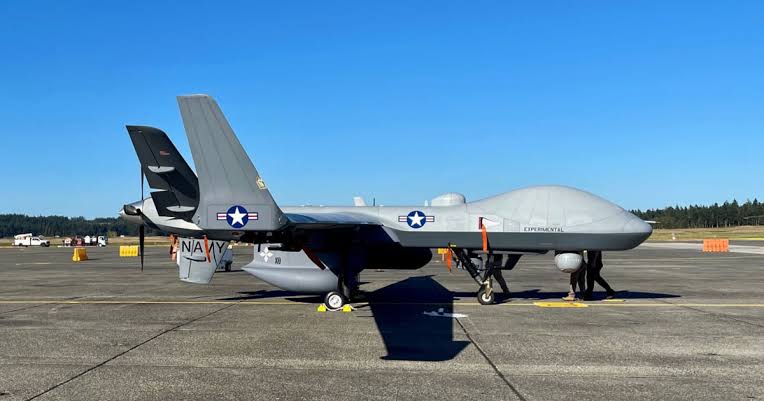
The United States has deployed multiple MQ-9 drones and about 200 troops to Nigeria to support the country’s fight against insurgency through intelligence and training, according to a report by Reuters.
The deployment, confirmed on Saturday by U.S. and Nigerian officials, is focused strictly on surveillance and advisory roles, with no American troops engaged in combat operations.
“The U.S. military has multiple MQ-9 drones operating in Nigeria alongside 200 troops to provide training and intelligence support to the military,” officials told Reuters.
The report stated that the mission was requested by Nigerian authorities to strengthen efforts to identify, track, and respond to terrorist threats, particularly in the northern region.
A U.S. defence official described the operation as a joint security effort, saying, “We see this as a shared security threat,” while emphasising that the role of U.S. forces remains limited to intelligence collection and advisory support.
Nigeria’s Director of Defence Information, Major General Samaila Uba, confirmed that the U.S. personnel are operating from an airfield in Bauchi State.
“This support builds on the newly established U.S.-Nigeria intelligence fusion cell, which continues to deliver actionable intelligence to our field commanders. Our U.S. partners remain in a strictly non-combat role, enabling operations led by Nigerian authorities,” Uba said.
The MQ-9 drones—also known as Reaper drones—can remain airborne for over 27 hours and are capable of both surveillance and strike missions. However, officials clarified that those currently deployed in Nigeria are being used exclusively for intelligence gathering.
“Our U.S. forces are helping Nigeria identify, track and respond to terrorist threats,” Uba added, without providing details of specific operations.
The development comes amid renewed attacks in parts of northern Nigeria. On March 16, suicide bombers struck a garrison town in the northeast, highlighting the persistent threat posed by Boko Haram and Islamic State West Africa Province (ISWAP).
“We continue to assess that these organisations will seek opportunistic targets and may attempt to demonstrate relevance through high-visibility attacks,” Uba said.
The Nigerian military noted that the duration of the U.S. deployment would be determined jointly by both countries.
The report further recalled that the U.S. had earlier deployed troops to Nigeria in February to enhance counterterrorism efforts through training and intelligence support.
Additionally, American airstrikes carried out on Christmas Day under President Donald Trump were part of a broader security partnership aimed at combating extremist groups in Nigeria.
The ongoing collaboration reflects increased focus on intelligence-sharing and capacity-building as Nigeria intensifies efforts to curb insurgency across affected regions.