










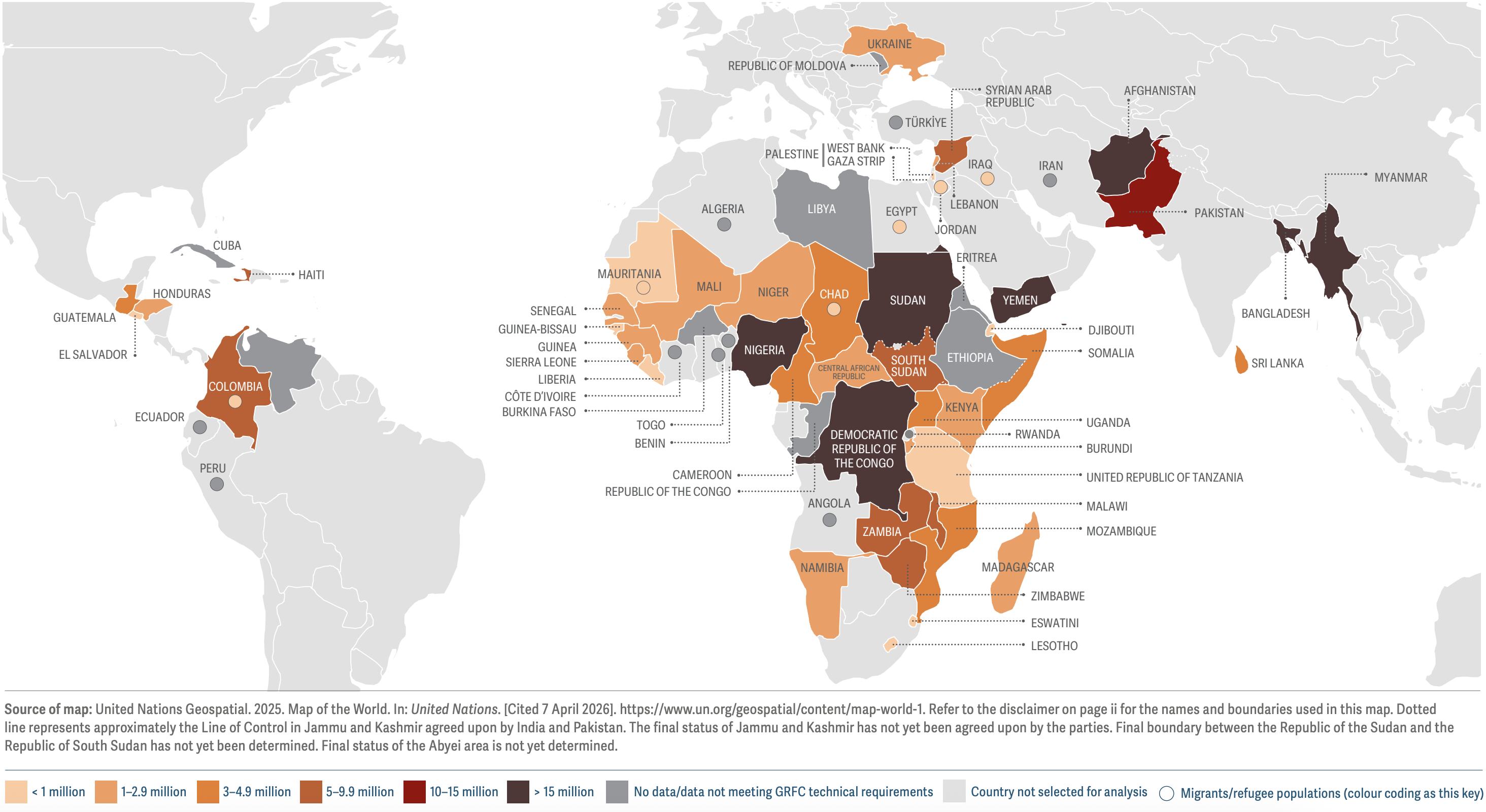
The 2026 Global Report on Food Crises on Friday revealed that two-thirds of all people facing high levels of acute hunger are concentrated in just 10 countries.
The report from the Global Network Against Food Crises further revealed that acute food insecurity remains highly concentrated in the countries, including Nigeria.
“Ten countries namely, Afghanistan, Bangladesh, the Democratic Republic of the Congo, Myanmar, Nigeria, Pakistan, South Sudan, Sudan, Syrian Arab Republic, and Yemen. accounted for two-thirds of all people facing high levels of acute hunger.”
The major international report also finds that 266 million people across 47 countries experienced high levels of acute food insecurity in 2025.
This figure, which was released by an alliance of UN agencies, the EU, and partners, found that nearly a quarter of the population was analysed and almost double the share recorded in 2016.
The report found that conflict remains the primary driver, accounting for more than half of all people facing severe hunger.
“Acute food insecurity today is not just widespread – it is also persistent and recurring,” UN Food and Agriculture Organisation (FAO) Director-General Qu Dongyu, said.
Qu warned that the crisis has become structural rather than temporary.
UN Secretary-General António Guterres wrote the foreword of the report.
“This report is a call to action” “to summon the political will to rapidly scale up investment in lifesaving aid, and work to end the conflicts that inflict so much suffering on so many.”
The report also highlights more than 39 million people in 32 countries faced emergency levels of food insecurity, while the number of people experiencing catastrophic hunger has increased ninefold since 2016.
The report says children are among the most affected as 35.5 million children were acutely malnourished, including nearly 10 million suffered from severe acute malnutrition in 2025.
