








Top Headlines

Stakeholders renew commitment to end rabies by 2030

Published on September 29, 2026 | By Agency Report

Share with friends:

news


Stakeholders in the livestock, environment and health sectors have renewed their commitment to ending rabies by 2030 through sustained public awareness, animal vaccination and improved access to post-exposure treatment.


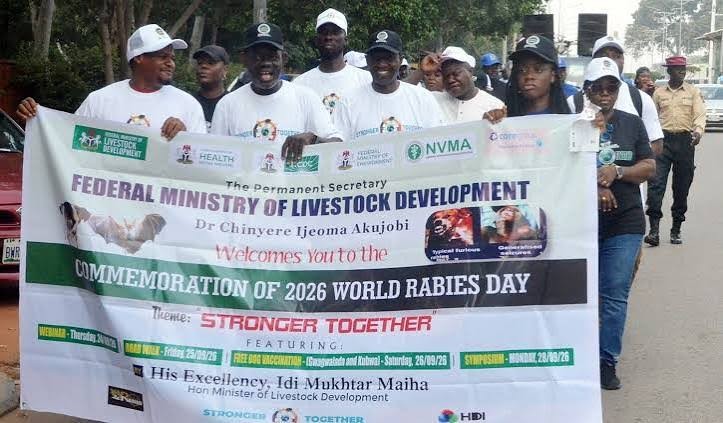
They made the commitment at a symposium in Abuja to commemorate the 2026 World Rabies Day.


The stakeholders included the CORE Group Partners Project, Nigerian Veterinary Medical Association (NVMA), World Health Organisation (WHO) and War Against Rabies Foundation, among others.


Dr Lami Samaila, Secretariat Director, CORE Group Partners Project, said sustained awareness, responsible animal ownership, timely reporting and surveillance were critical to preventing rabies.


Samaila said effective management of animal bites and access to life-saving post-exposure prophylaxis required collaboration between the human and animal health sectors.


“Our approach recognises that there is an important connection between human and animal health.


“If we want to do everything regarding proper management of animal bites and giving life-saving post-exposure prophylaxis, no sector can do it alone,” she said.


She said the project would continue to support government and partners in strengthening community awareness, addressing misconceptions and promoting preventive measures.


Dr Chinnaemeka Joe-Iruobe, Chairperson, FCT Chapter of NVMA, called on the Federal Ministry of Health and Social Welfare to ensure availability of human rabies vaccines.


Joe-Iruobe also urged stronger collaboration with the Ministry of Environment to address the presence of stray dogs in communities.


She cited a recent report of 10 people bitten by a rabid dog in Kano, saying the incident underscored the need for stronger inter-sectoral action.


“Do not leave the fight against rabies to the animal health sector alone because we cannot do it alone.


“It affects you and us. So, let us come together and play our part to eradicate rabies by 2030,” she said.


Earlier, Dr Alexander Chimbaru, Deputy Country Representative of WHO, who spoke on behalf of Dr Pavel Ursu, WHO Representative in Nigeria, said children aged five to 14 were among those most affected.


He said about 40 per cent of rabies cases globally affected children, stressing the need for greater awareness and protection of children.


Chimbaru said rabies imposed a global economic burden estimated at 8.6 billion dollars annually through healthcare costs, psychosocial effects and lost productivity.


He called for greater awareness on dog vaccination, early treatment and responsible dog ownership, as well as improved access to post-exposure prophylaxis.


“The dogs belong to the communities. The children are suffering in the communities.


“So what is critical is to raise awareness about dog vaccination, early treatment, how to manage our dogs, as well as availability of post-exposure prophylaxis across the country and globally,” he said.


Enjoyed this article? Share it with friends!