










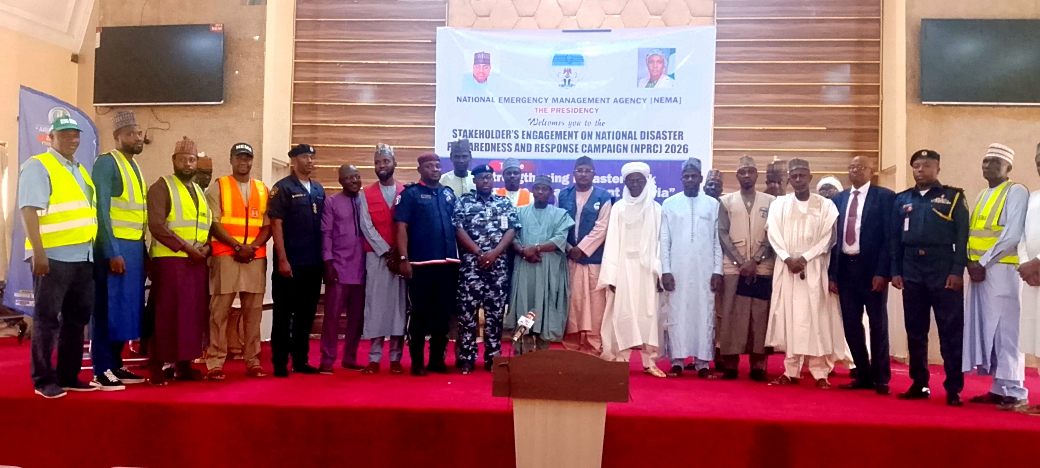
The National Emergency Management Agency (NEMA) has engaged critical stakeholders in Kebbi to strengthen preparedness and enhance coordinated response toward mitigating the impact of anticipated flooding during the 2026 rainy season.
The Director-General of NEMA, Mrs Zubaida Umar, said this at the flag-off of the 2026 National Preparedness and Response Campaign on Flood Disaster and Related Hazards held in Birnin Kebbi on Friday.
Represented by the Director, North-West Zonal Directorate, Mr Aliyu Shehu-Kafindangi, Umar said the engagement was aimed at promoting early action, risk reduction and community resilience against flood-related disasters across the state.
She said the areas predicted to be affected LGAs were Argungu, Augie, Bagudu, Birnin Kebbi, Dandi, Fakai, Koko-Besse, Maiyama, Ngaski, Shanga, Zuru and Yauri.
She added that the July-August-September period would be the most critical phase, with the Kebbi River expected to overflow its banks and inundate farmlands, riverside communities and critical infrastructure.
According to her, elevated water levels are also projected to persist into October and November, thereby prolonging the impact of flooding in affected areas.
“The recurrent impact of flooding in Nigeria demands urgent and collective response.
“Each year, lives are lost, livelihoods disrupted, while public and private infrastructure worth billions of naira are destroyed,” she said.
Mrs Umar explained that the prediction was based on the 2026 Seasonal Climate Prediction and Annual Flood Outlook released by the Nigerian Meteorological Agency (NiMet) and the Nigeria Hydrological Services Agency (NIHSA).
She disclosed that 23 states, including the Federal Capital Territory (FCT), covering 132 LGAs, had been classified as high flood-risk areas, while 14 other states with 148 LGAs were categorised as moderate-risk areas.
The D-G said NEMA had already developed the 2026 Climate-Related Risk Management, Preparedness and Mitigation Framework to reduce flood impact nationwide.
She listed key mitigation strategies to include capacity building for local responders, simulation and tabletop exercises, adherence to rainfall and flood advisories, prepositioning of relief materials, infrastructure integrity assessment and development of community evacuation plans.
According to her, NEMA has also produced vulnerability maps for identified communities and deployed technical teams across states for grassroots sensitisation and early warning campaigns.
