










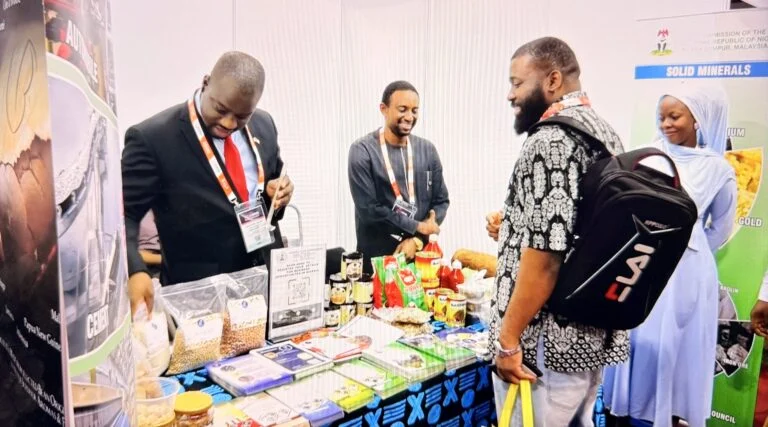
Nigeria has no shortage of products with the potential to compete in international markets.
From sesame and hibiscus to shea butter, yam, cassava and other agricultural commodities, Nigerian producers have access to raw materials with demand beyond the country’s borders.
Yet a persistent question remains: why do Nigerian products with strong production potential struggle to achieve sustained access to global markets?
Interviews with government officials, diplomats, exporters, entrepreneurs and business operators at the Malaysia International Halal Showcase, MIHAS 2026, explains why.
The challenge is not simply a lack of products, but rather the systems required to make those products acceptable, competitive and sustainable in international markets.
Between a Nigerian farm, factory or processing facility and a foreign supermarket shelf lies a chain.
These include certification, quality control, processing, packaging, financing, regulation, logistics, market intelligence and business relationships.
Where that chain is weak, a product may have demand and still fail to become a successful export.
For Alh. Magaji Kamal, Chief Executive Officer of Silkim Group and Vice President of Nigerian Entrepreneurs in Malaysia, the consequences can be seen in the experience of Nigerian exporters.
Kamal recalled an attempt to export cassava flour processed in Kano to Mauritius.
Although the product reached Mauritius, it was not accepted for human consumption after inspection detected traces of dust, stones and other contaminants.
The experience, he said, demonstrated the need for Nigerian processing facilities to meet the hygiene and quality requirements of destination markets before products are exported.
“Some companies have already started, but a lot of us are left behind,” Kamal said.
The episode illustrates what could be described as the last-mile problem of Nigerian exports.
Producing a commodity is one thing; producing it consistently to internationally acceptable standards is another.
Kamal said Nigerian commodities including hibiscus flower, sesame and crayfish were already finding their way into the Malaysian market.
He noted, however, that crayfish was largely purchased by Nigerians living in Malaysia, while some other Nigerian commodities were also consumed by Malaysian customers.
That distinction is significant. Diaspora demand demonstrates that a market exists.
However, moving from diaspora consumption to mainstream international consumption requires businesses to understand foreign consumers, regulations, certification and distribution systems.
Kamal also said some Nigerian entrepreneurs operating in Malaysia needed better knowledge of the country’s formal business environment.
He said some continued to rely on informal practices, including operating without proper registration or offices, avoiding tax obligations and conducting transactions outside formal regulatory structures.
“Once you are doing everything by the book, there is a lot of support that the government can give you, whether you’re an international company or a local company,” he said.
He said many entrepreneurs were willing to comply but lacked adequate information on how to navigate the system.
It was partly in response to this gap, he said, that they established the Nigerian Entrepreneurs in Malaysia.
He explained that the group provides information on registration, taxation, licensing, halal certification and other requirements for operating in the country.
The implication is important: market access is not determined by demand alone.
It is also determined by whether businesses understand and can comply with the rules of the destination market.
For Ali Saidu, Chief Executive Officer of Salid Agricultural Nigeria Ltd., certification represents another major barrier.
Saidu said international buyers of Nigerian shea butter in countries including Russia, the Netherlands and India require halal certification before purchasing the product.
He argued that Nigeria should see the halal economy beyond its religious dimension and recognise it as an international trade opportunity and a potential channel for expanding non-oil exports.
“The global Halal economy is not just about religion, but it’s about an international trade certification applicable to the world,” he said.
Saidu said Nigerian businesses sometimes had to seek certification through countries such as South Africa and Kenya.
He argued that the absence of accessible and internationally recognised certification systems in Nigeria could result in lost business opportunities.
The problem, he said, was not merely whether Nigeria could produce shea butter or other commodities, but whether exporters could efficiently obtain the certifications required by buyers.
Mrs Isioma Ona, Managing Director of Ecoepicure Ltd, said Malaysian consumers and African communities in Malaysia had shown interest in Nigerian products.
According to her, they identify shea butter, bitter kola and yam among products with potential.
She stressed that Nigerian exporters needed to understand Malaysian certification and import requirements.
The entrepreneur explained that this was because compliance with Nigerian requirements alone would not guarantee access to the Malaysian market.
That points to a broader reality of international trade, which is that a product is not globally competitive simply because it is acceptable at home.
It must meet the technical, sanitary, regulatory, packaging and certification requirements of the market where it is sold.
The opportunity also extends beyond exporting finished products.
Mr Noah Ibitoye, Chief Executive Officer of ZyNooh Store Nigeria, was upbeat about his exposure to Malaysian manufacturing.
He said the exposure increased his interest in encouraging Malaysian companies to establish manufacturing operations in Nigeria.
Such investment, he argued, could create opportunities for technology transfer, local production and greater use of Nigerian raw materials.
This could help Nigeria move beyond an import-dependent relationship and capture more value locally before products enter international markets.
The diplomatic perspective points in the same direction.
Amb. Ahmed Sulu-Gambari, Nigeria’s High Commissioner to Malaysia, said Nigeria needed to learn from Malaysia’s economic experience.
According to him, this will strengthen collaboration between Nigerian and Malaysian business communities.
He said the mission was working to attract more Malaysian companies to Nigeria while engaging businesses and authorities to address concerns that could discourage investment.
Sulu-Gambari said economic diplomacy should ultimately produce measurable benefits for Nigeria.
“The world is moving from the rhetoric of meetings in and out.
”These meetings to action, what are the benefits, the direct, derivable benefits to Nigeria?” he said.
The question, he said was particularly relevant to international exhibitions.
“Nigerian businesses can meet potential buyers and investors but may struggle to convert those encounters into actual transactions,” he said.
