










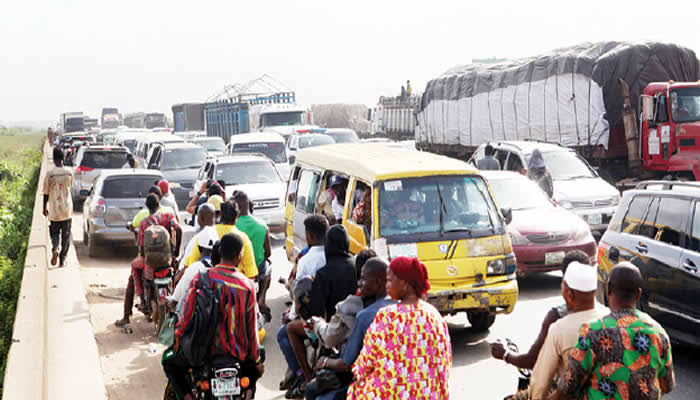
Motorists and commuters across Lagos are facing rising transportation costs following another increase in the pump price of petrol, which now sells for between N1,250 and N1,350 per litre at filling stations.
A survey by the News Agency of Nigeria (NAN) on Sunday showed growing concern among road users as the increase, driven largely by global supply pressures and domestic price adjustments, continues to influence transportation expenses.
The latest increase follows another upward review of petrol prices by the Dangote Petroleum Refinery, which raised the gantry price of Premium Motor Spirit (PMS), commonly known as petrol, to N1,175 per litre from N995 earlier in the week.
The adjustment represents an increase of N180, about 18.1 per cent within three days, marking the refinery’s third price review within the week and prompting swift adjustments across the downstream market.
Industry sources attribute the rise partly to heightened geopolitical tensions in the Middle East, particularly the escalating standoff between Israel and Iran, as well as attacks linked to Yemen’s Houthi movement in the Red Sea corridor.
The instability has forced many oil tankers to reroute from traditional shipping lanes, pushing global freight costs up by roughly 40 per cent, according to market data from the Baltic Exchange.
At the same time, international oil prices have risen, with Brent crude approaching 99 dollars per barrel, while the Nigerian currency trades at about N1,650 to the dollar, factors analysts say are contributing to higher domestic fuel prices.
However, with the emergence of the Dangote refinery, Nigeria continues to rely significantly on imported refined petroleum products.
The spokesperson for the refinery, Mr Anthony Echiejina, said the price adjustment reflects rising feedstock and logistics costs associated with developments in the global energy market.
Checks by NAN revealed that retail prices have increased across several outlets in Lagos, with petrol selling between N1,200 and N1,350 per litre depending on location.
Major marketers have also adjusted their pump prices. MRS Oil Nigeria Plc and Matrix Energy Group sell petrol at about N1,250 per litre, while outlets of Ardova Plc (formerly AP) retail the product at around N1,300 per litre.
Some independent stations charge slightly higher prices.
A NorthWest outlet in the Gbagada area dispensed petrol at about N1,250 per litre, while several other stations across the metropolis sold the product close to the N1,200 mark.
At a Mobil Station along the LASU–Isheri Road corridor, petrol was sold at N1,250 per litre, while Petrocam Station nearby dispensed fuel at the same price.
Similarly, MRS stations in parts of Alimosho sold petrol at about N1,250 per litre, while Mobil outlets in Alaguntan and Iyana Ipaja recorded prices of N1,250 and N1,350 per litre respectively.
Other stations, including Heyden outlets in Iyana Ipaja and along the Oshodi–Abeokuta Expressway, also sold petrol at about N1,250 per litre, reflecting a broad market trend.
Meanwhile, market insiders have said pricing differences were increasingly influenced by variations in product sourcing, particularly between coastal marine lifting arrangements and gantry loading operations.
