










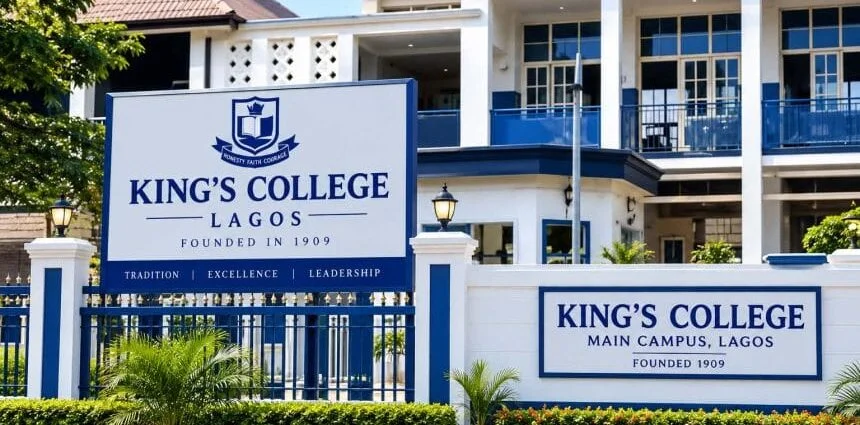
For generations of Nigerians, King’s College, Lagos, has been more than a secondary school; it has been a symbol of academic excellence and a training ground for future leaders.
Founded during the colonial era, this institution shaped generations of Nigerians who later attained prominent positions across government, business, academia, and various professional sectors.
Its name became associated with discipline, academic excellence and the idea of bringing young Nigerians from different parts of the country together to learn and grow.
But decades of inadequate investment and deteriorating infrastructure have raised questions about whether the institution still reflects the reputation for which it became renowned.
Against this backdrop, the Federal Government and the King’s College Old Boys Association (KCOBA) agreed on a Public-Private Partnership (PPP) concession for the institution.
The proposal has generated controversy, with education unions opposing the move.
While the government insists the arrangement is not a sale or privatisation, the dispute has triggered heated debates over how best to preserve the school’s legacy while addressing its deteriorating infrastructure and standards.
The unions have raised concerns around the proposed arrangement, particularly its implications for staff, the future of the school and the possibility that it could become a precedent for other unity colleges.
At the centre of the disagreement is a fundamental question: how can government restore the quality and infrastructure of institutions that once represented the pinnacle of public education?
The Minister of Education, Dr Tunji Alausa, said the Federal Government had no plan to sell any of the country’s Federal Unity Colleges.
He described reports suggesting otherwise as misinformation, stressing that government retained responsibility and ownership of the institutions.
“Federal Government of Nigeria, through the Federal Ministry of Education, is not going to sell any of our Federal Unity Colleges; that is the government position, and go and write it down and hold on to that.
“So, if the unions start telling you that, ‘Oh, they are protesting because they want to sell unity colleges,’ that is absolutely false.
“We are not selling any of our Federal Unity Colleges. Government still has its responsibility.”
He said the arrangement involving King’s College was intended to address the school’s infrastructure and management challenges while restoring its historic status.
He said that King’s College was established to provide an environment capable of producing leaders, much like some renowned institutions globally that have historically served as pipelines for national leadership.
He cited Eton College in the UK and Ivy League universities in the U.S. as examples of institutions that have played important roles in developing generations of leaders.
Alausa argued that Nigeria once had similar institutions, pointing to King’s College, Lagos and Barewa College, Zaria as examples of schools that produced prominent Nigerians across generations.
However, he said the condition of some unity colleges had deteriorated significantly after decades of accumulated infrastructure deficits.
Alausa recalled that after assuming office, he and the Minister of State for Education, Prof. Suwaiba Ahmad, split the country’s regions to inspect the condition of Unity Colleges.
He said his visit to King’s College was conducted unannounced and began at about 7:30 a.m.
Alausa reported encountering a school struggling with serious infrastructure and environmental challenges during the inspection.”
He described the toilets and bathrooms as being in poor condition and the students’ dormitories as severely dilapidated.
The minister also expressed concern about the condition of the dining facilities, classrooms and laboratories, saying some areas were poorly lit and had accumulated refuse.
He said the school had also experienced prolonged electricity challenges, recalling how he contacted the management of the electricity distribution company serving the area and insisted that power be restored to the school.
“I will not leave this school today if you do not come and connect this school back to electricity,” he recalled telling the company’s chairman.
He said electricity was subsequently restored to the Senior Secondary School, explaining that the condition he encountered was not limited to one section of King’s College, adding that the Junior Secondary School also required substantial rehabilitation.
Alausa also revealed that another issue that caught his attention during the inspection was the use of parts of the school premises as a car park.
The minister said he observed about 200 vehicles parked in one part of the compound and additional vehicles close to the gate.
He questioned the safety implications of operating a public car park within the premises of a school largely occupied by children.
The minister said he directed the cancellation of the arrangement, expressing concern that unrestricted access to the school could expose students to security risks.
This incident, according to him, highlights the larger management difficulties faced by several unity colleges.
For the Federal Government, the King’s College controversy is therefore not simply about the management of one school but part of a larger debate about the sustainability of public education and the future of the country’s unity colleges.
Alausa said government funding alone might not be sufficient to close decades of infrastructure gaps across the schools.
He estimated that the cost of rehabilitating unity colleges would run into hundreds of billions of naira, noting that government had other competing priorities, including healthcare, security and broader infrastructure.
