










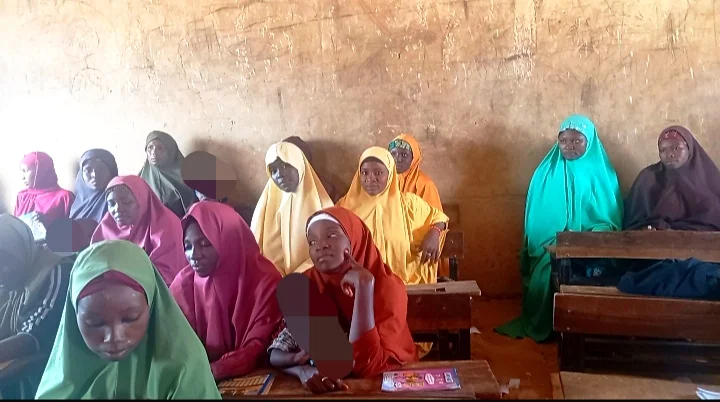
With a toddler on her lap, and a book resting on the desk before her, a young mother sits among other women in colourful hijabs.
In the modest classroom, the women listen attentively to their teacher, who reads a text on the blackboard, repeating after him.
For these married adolescent girls in Bugau, in Damau ward of Kubau Local Government Area, Kaduna, motherhood did not end their desire for education.
After being forced out of school by early marriage, they are now finding their way back to the classroom, determined to reclaim an opportunity they once lost.
They attend classes four times a week, learning how to read and write in Hausa and English, with classes starting at 8:30am and ending at 10:00am.
In Bugau, girls are married off as soon as they attain puberty.
It is a popular belief that education is for the boy child, while the girls are meant to marry, bear children and take care of the family.
“In our household, my family do not believe in educating girls. They only sent my brother to school. He has now finished secondary school and continues his education in a different town.
“When I asked why girls weren’t allowed to study, I wasn’t given a clear reason, but there was a general belief that educating girls was not useful and that it was only beneficial for boys,” Basira Isah, 15-year-old married adolescent, says.
Isah, who was married off at the age of 13 and relocated to Bugau, where her husband lives, said she was born and raised in Mabuga, a community near Bugau where she attended primary school.
However, her education was cut short at primary 3, due to lack of teachers.
According to her, their teachers were not from their village, so they travelled from other places to teach them, mostly once a week, and eventually, they stopped coming; a situation which affected their education.
Instead of wandering around playing, Isah stayed home and helped her mother sell ‘kunu’ (a traditional drink) at the market to support the family.
She was later married off to a suitor chosen by her father, in spite of her resistance.
But Isah wasn’t the only girl with this experience.
Hadiza Danjuma is another married adolescent. She was married off at the age of 14 after dropping out of school in JSS 2.
She attended primary school in Bugau, the only school in the community, and later moved to Damau, a town about 10 kilometres from her community, to attend secondary school.
She said she met her husband when she was 13, when he revealed his intention to marry her, but she told him she wasn’t ready.
Unlike Isah, Danjuma courted her husband for one year before her father decided it was time to marry her off.
“In Bugau, honestly, not everyone finishes school; some only finish primary school.
“For those whose parents are resilient, and if the girls start school at an early age, they are the ones who might finish primary school, JS 1, or JS 2 before getting married,” she said.
Another married adolescent, Zainab Shehu, aged 14, said she was the first female child enrolled in school up to secondary school level.
But that would not be completed, as she was also forced to drop out at JSS 2 for marriage.
She met her husband while returning from school, where he showed interest in her, but she did not reciprocate.
Subsequently, the suitor went directly to her parents to reveal his intention for marriage and asked for her hand when she was just 12 years old.
“At that time, honestly, whenever a suitor came, I would just run away. I wasn’t interested in chatting with men.
“Even if you greeted me, I wouldn’t answer you, I would just pass by. And if anyone visited me at home, I would just say my greetings and sit down, that’s all.
“I wouldn’t talk to you; you’d just get tired, stand up, and leave,” she said, while smiling.
Beyond these individual accounts, the wider figures paint a sobering picture.
Early marriage remains a major challenge in Kaduna, especially in parts of the Kaduna North senatorial zone.
The 2021 Nigeria Multiple Indicator Cluster Survey (MICS) found that 45.3 per cent of women aged 20 to 49 in Kaduna had entered marriage or union before age 18, while 18.3 per cent had married before age 15.
Findings from the Kaduna General Household Survey similarly showed that more than 30 per cent of girls in Kubau Local Government Area were married before age 15.
This trend has, in turn, contributed to the increased number of Out-of-School Children (OOSC) in the state.
According to the 2026 Kaduna State Out-of-School Children (OOSC) Mapping, 187,719 children aged 3–17 years are out of school across the state’s 23 Local Government Areas (LGAs).
The mapping showed that boys accounted for 57 per cent of the total, while girls constituted 43 per cent, with children aged six to 11 years representing 65 per cent of the identified population.
Of the total, 60.2 per cent had never enrolled in school, while 39.8 per cent had enrolled but dropped out.
Kaduna North Senatorial Zone accounted for 51 per cent of the state’s out-of-school children, making it the zone with the highest concentration.
It is against this backdrop that three married adolescent girls; Basira, Hadiza and Zainab, introduced a school for married women in their community.
This was after a non-governmental organisation, Participatory Communication for Gender Development (PAGED) Initiative, trained them on literacy and the importance of education.
PAGED Initiative is a non-profit, non-governmental organisation on a mission to foster inclusiveness and equity in every aspect of life in Nigeria.
It promotes participatory communication in society by ensuring that marginalised groups are understood and empowered, and that women and men are encouraged to work together towards achieving parity for all.
