










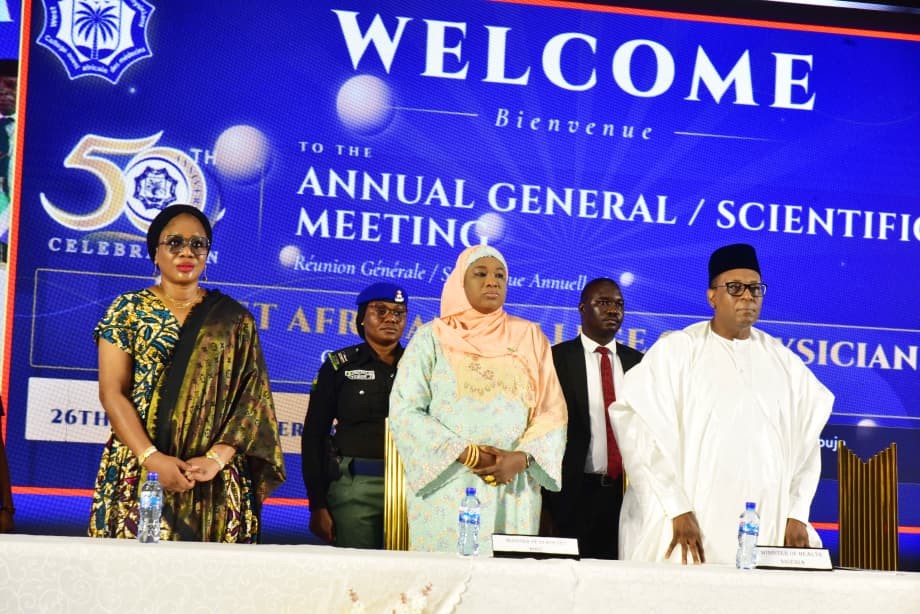
President Bola Tinubu says his administration has recruited more than 30,000 healthcare professionals into federal health facilities in the past two and a half years to strengthen Nigeria’s health system.
Tinubu, represented by Coordinating Minister of Health and Social Welfare, Prof. Muhammad Pate, spoke at the opening of the West African College of Physicians (WACP) 50th Annual General Meeting and Scientific Conference in Abuja on Monday.
He said the government had prioritised healthcare workforce recruitment, retention, welfare and training, recognising that the performance of any health system depended largely on the strength of its workforce.
The president said the administration had doubled quotas for medical education and supported the training of tens of thousands of frontline health workers to improve access to quality healthcare.
He added that the government was investing in postgraduate medical education, specialist institutions and digital innovations to improve healthcare management, patient records, disease surveillance and data-driven decision-making.
Tinubu said the measures formed part of broader reforms aimed at advancing universal health coverage and ensuring equitable access to healthcare services for Nigerians across the country.
He said the government had invested in constructing, rehabilitating and equipping health facilities, while revitalising primary healthcare centres and increasing direct financing through the Basic Healthcare Provision Fund.
The president also said the administration had expanded health insurance coverage to bring more Nigerians under financial protection against catastrophic healthcare expenditure and reduce the burden of medical costs.
On healthcare professionals’ migration, Tinubu said the government would work to stem the trend and encourage health workers to return to Nigeria and other countries in the region.
Tinubu called for stronger regional cooperation to prevent and control infectious disease outbreaks, including Ebola virus disease, through improved surveillance, laboratory networks, emergency preparedness and cross-border collaboration.
He said Nigeria was ready to work with WACP, ECOWAS, the African Union and other partners to strengthen regional health security, while urging medical institutions to embrace innovation responsibly.
Earlier, WACP President, Dr Mamadou-Mourtalla Ka, said the college had trained and certified thousands of specialist physicians who contributed to clinical practice, medical education, scientific research and health leadership across West Africa and beyond.
Ka said the golden jubilee provided an opportunity to reflect on the institution’s achievements since its establishment in 1976 and consider its responsibilities in improving healthcare delivery across the sub-region.
He said the college’s founding fathers had established it with a clear vision of promoting excellence in postgraduate medical education, strengthening professional standards and improving healthcare quality across West Africa.
According to him, achievements recorded over five decades resulted from successive generations of physicians who sustained the college’s commitment to specialist training and professional development.
The president paid tribute to the founding fathers, past presidents, senior fellows, teachers and mentors whose dedication and perseverance had helped build the institution over the years.
He said their contributions should inspire current members to preserve the college’s values, strengthen its unity and prepare the next generation of physicians for emerging healthcare challenges.
