










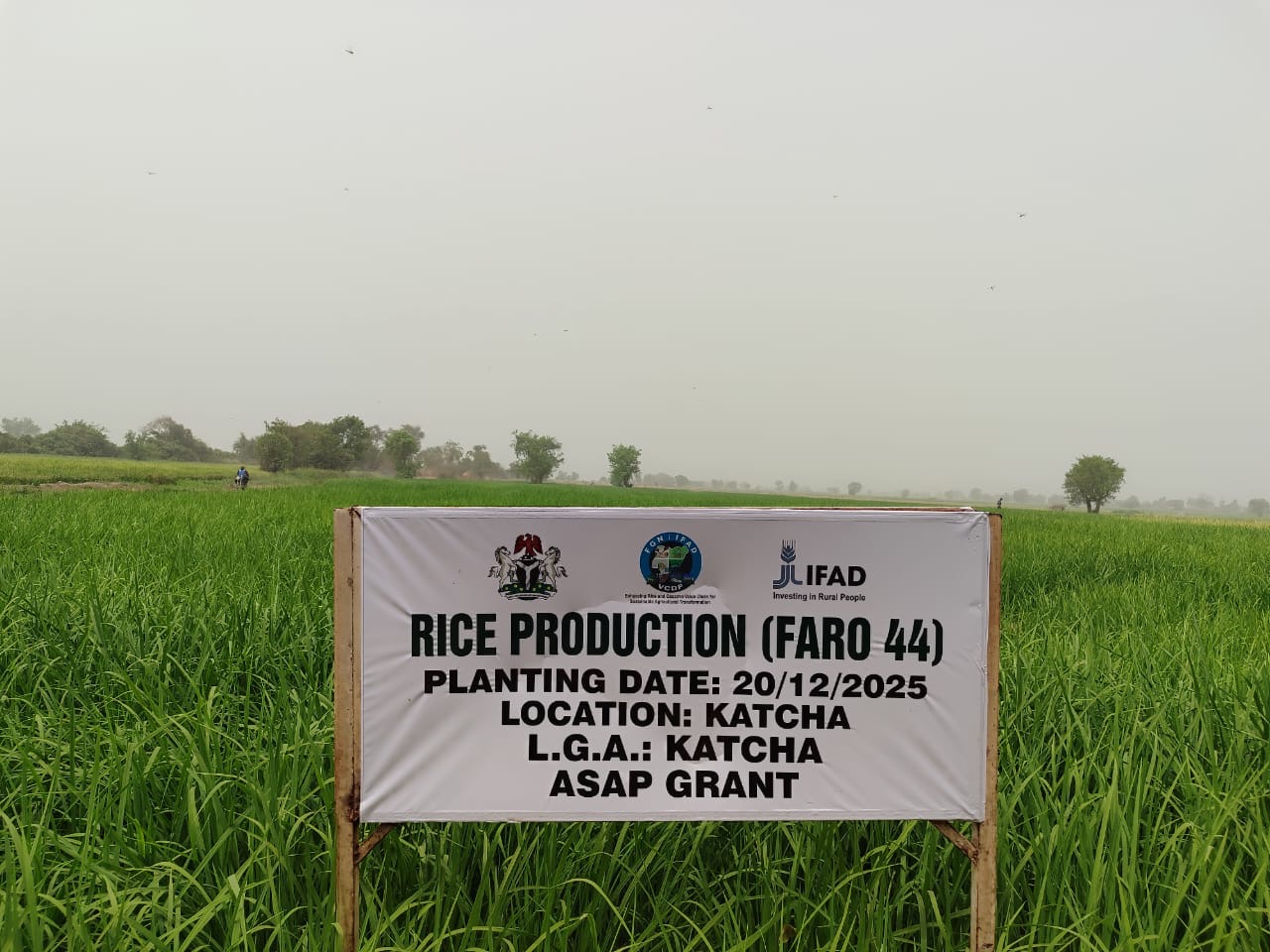
The Federal Government, through the International Fund for Agricultural Development (IFAD)-supported Value Chain Development Programme (VCDP), has recorded major gains in rice and cassava production in Niger State following the rollout of the Adaptation for Smallholder Agriculture Programme (ASAP) grant.
A field tour of intervention sites in Katcha and Bida LGAs showed expanded farm sizes, bumper harvests, and thriving waste-to-wealth enterprises among beneficiaries.
The tour covered Bangi Farmers Cooperative and Emiworo community in Katcha, as well as the Dabarako Cassava Processing Centre in Bida.
ASAP is a global IFAD initiative integrated into Nigeria’s VCDP to channel climate finance directly to smallholder farmers and strengthen food-system resilience.
The programme operates in Bida, Borgu, Edati, Katcha, Mokwa, and Wushishi LGAs of Niger State.
It supports producers, processors, marketers, women cooperatives, and youth groups in the rice and cassava value chains.
The State Programme Coordinator, Hajiya Hadizat Isah, said the grant commenced in March 2025 in Niger and Kogi states.
She said Niger accounts for 18,710 beneficiaries out of 24,000 farmers supported in the two states.
Isah added that 1,410 beneficiaries in Katcha LGA are cultivating about 500 hectares under the scheme.
She said ASAP focuses on climate resilience, sustainable production, and innovative waste-to-wealth technologies.
According to her, farmers received improved climate-resilient rice seeds and high-yield cassava stems, including Vitamin A varieties.
