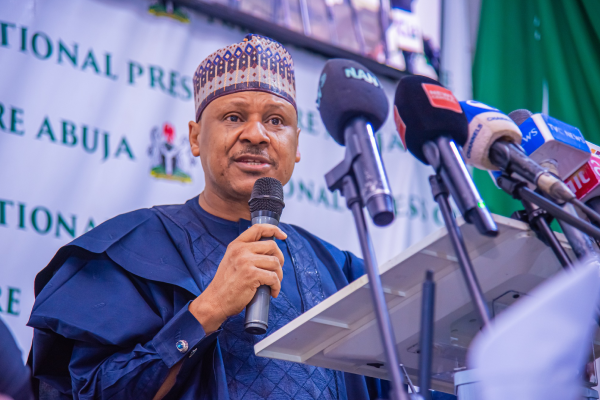
President Bola Tinubu has reaffirmed commitment to strengthen collaboration with traditional institutions to advance peace, security, national cohesion and sustainable development in Nigeria.
He said this at the 8th Executive Committee Meeting of the Northern Traditional Rulers’ Council (NTRC), on Monday in Dutse, Jigawa.
The theme of the meeting is: “Peace, Unity and Development of the North.”
Tinubu was represented by Mr Mohammed Idris, Minister of Communication and National Orientation.
The president said that his administration recognised the strategic roles of traditional institutions and remained committed to deepening engagement with them toward advancing peace, security, national cohesion and development.
He commended the council under the leadership of the Sultan of Sokoto, Muhammad Sa’ad Abubakar III, for its continued contributions to peace, unity, security and development in northern Nigeria.
According to Tinubu, peace remains the foundation of development and prosperity, without peace, development becomes difficult; without unity, progress cannot be sustained.
“The pursuit of both must remain our collective responsibility,” he said.
Tinubu described traditional rulers as critical partners in governance and peace-building in view of their close relationship with communities and their ability to mobilise citizens around important national objectives.
“Across generations, our traditional rulers have served as custodians of culture and values, mediators in times of conflict, and trusted bridges between government and the people.
“Your proximity to the grassroots and your moral authority make you indispensable partners in governance, peace-building, and community mobilisation,” he said.
On security, Tinubu said that his administration has continued to strengthen coordination among the armed forces, intelligence agencies and other security institutions, leading to significant gains against criminal and terrorist groups across the country.
“While challenges remain, the administration is sustaining military operations, improving intelligence gathering, and enhancing inter-agency collaboration. At the same time, we recognise that lasting peace cannot be achieved through security operations alone.
“We must also address poverty, unemployment, social exclusion, and the lack of economic opportunities that often fuel insecurity,” the president said.
Tinubu also highlighted economic initiatives of the federal government aimed at creating jobs, improving livelihoods and supporting long-term growth, including interventions in agriculture, livestock development, solid minerals, infrastructure, education financing, consumer credit and support for small businesses.
Gov. Umar Namadi of Jigawa, said the northern region was facing serious development challenges, including insecurity, poverty, unemployment, climate pressures, farmer-herder conflicts, drug abuse, out-of-school children, and weakening community values.
According to Namadi, addressing these challenges requires sustained cooperation among state governments, traditional institutions, religious leaders, civil society, security agencies, and the citizens.
“In this regard, we commend the Northern States Governors’ Forum for promoting stronger collective action and deeper collaboration with the Council of Traditional Rulers towards lasting peace, security, stability, and development in the region.
“It is also important to recognise the ongoing efforts of the Federal Government of Nigeria, under the leadership of President Bola Tinubu, to find lasting solutions to insecurity, not only in the North-West but across the north and Nigeria as a whole.
“We appreciate the renewed commitment to intensified military and intelligence operations, improved coordination among security agencies, and stronger collaboration with state governments,” he said.
Namadi also commended the NTRC for consistently placing peace and security at the centre of its engagements during the 7th Executive Committee Meeting held in Maiduguri, and the 2025 General Assembly in Birnin Kebbi.
He highlighted that the message remained clear: peace, security, and stability are indispensable, and stronger cooperation between traditional rulers and government is absolutely necessary.
Also, Gov. Inuwa Yahaya of Gombe State, said the security situation in the northern region had reached a point where silence, hesitation and routine responses were no longer acceptable.
Yahya, who is the Chairman of the Northern State Governors’ Forum (NSGF), lamented that communities have been uprooted, farmers abandoned fertile lands, markets collapsed, schools shut down and millions of people displaced or forced to live in fear.
“The time has come for us to act with the seriousness this situation demands. Enough of meetings that do not produce results, enough of communiques that are not implemented, enough of promises that are not followed by action.
“The old methods are clearly not working. We cannot continue to confront rapidly changing security threats with outdated strategies and fragmented responses,” Yahaya said.
He recalled that during the NGSF meeting in December 2025, the forum resolved to establish a common Northern Security Framework, which is still on the drawing board because many of the governors have not honoured the obligations.
According to Yahaya, the next joint meeting of the forum with NTRC, scheduled to be held in Kaduna between July 11 and 12, 2026, must focus on actionable steps.
“We must place a clear and united request before the president and Commander-in-Chief of the Armed Forces, that northern Nigeria requires a new and decisive security strategy.
“There must be no safe havens for criminals, no tolerance for those who finance or collaborate with them, and no ambiguity in the government’s resolve to protect its citizens,” Yahaya said.
The Sultan of Sokoto, Muhammad Sa’ad Abubakar III, urged citizens to pray for leaders, and security agencies to overcome the challenges bedeviling the country.
Abubakar is also the chairman of the NRTC.
The Inspector-General of Police, Mr Olatunji Disu, described the NTRC as one of the most influential platforms for constructive engagement, consensus-building, and strategic reflection on matters affecting not only northern Nigeria but the peace, stability, and development of the nation as a whole.
Disu said the theme of the meeting was timely and profoundly significant, adding that it speaks directly to the aspirations of the people and reflects the urgent need for collective action in addressing the complex social, economic, and security challenges confronting the region and the country.
“Peace, unity and development are inseparable. Peace creates the environment for economic growth and social progress. Unity strengthens our collective resilience against threats to national cohesion.
“Development, in turn, addresses many of the underlying vulnerabilities that fuel insecurity, social unrest, and criminality. Where any one of these pillars is weak, the others inevitably suffer,” Disu said.
He noted that northern Nigeria occupies a unique place in the history and future of the nation being home to some of Nigeria’s most revered traditional institutions, vibrant commercial centres, agricultural assets, cultural heritage and human capital.
“The stability and prosperity of the north are therefore intrinsically linked to the stability and prosperity of Nigeria,” he said.
Disu said that the deliberations of the council were of immense national importance, adding that its recommendations have the potential to shape policies, strengthen institutions, foster social harmony, and contribute meaningfully to national development.