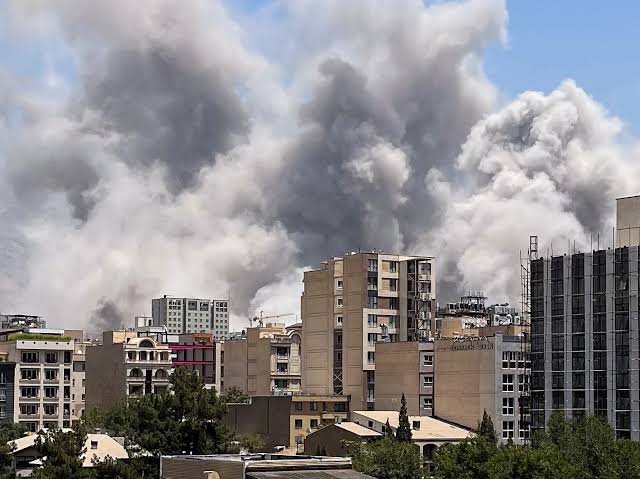
The confirmed killing of Iran’s Supreme Leader, Ali Khamenei, in a joint U.S.-Israeli strike marks one of the most consequential moments in Middle East geopolitics in decades.
What began as what Israel described as a “preemptive” strike has evolved into a confrontation with potentially global economic and security implications.
What happened in the past 24 hours?
Israel announced a “preemptive” strike early Saturday, deploying about 200 fighter jets in coordinated airstrikes targeting missile and defence systems in western and central Iran.
Shortly after, Trump said on his Truth Social platform that U.S. forces were “undertaking a massive and ongoing operation” targeting Iran’s missile industry.
Iran retaliated swiftly, declaring all U.S. military bases in the region legitimate targets. Explosions were reported in Bahrain, Qatar, Kuwait, Jordan, the United Arab Emirates and Saudi Arabia.
Iranian media reported that the Islamic Revolutionary Guard Corps had closed the Strait of Hormuz to shipping, declaring the vital oil and gas waterway unsafe due to U.S. and Israeli attacks.
The Iranian Red Crescent Society said strikes hit at least 24 of Iran’s 31 provinces, with 201 deaths and 747 injuries reported.
Up to 160 people could have been killed after airstrikes struck a school in southern Iran, according to Iranian Foreign Ministry spokesman Esmaeil Baghaei.
In Tehran, missiles struck near the offices of Khamenei and President Masoud Pezeshkian.
On Sunday, Iran’s government declared a 40-day mourning period following confirmation of Khamenei’s death.
Why did the United States and Israel take action now?
Trump said in an eight-minute video that the objective “is to defend the American people by eliminating imminent threats” from Iran.
Echoing that position, Israel’s Defence Ministry said the action aims to “remove threats to Israel.”
The U.S. Department of Defense, widely known as the United States Department of Defense, named the operation “Operation Epic Fury,” with officials indicating it could continue for days or weeks.
Unlike the June 2025 strikes that focused on underground nuclear facilities, the latest operation targeted multiple cities and leadership sites.
According to Israeli media, planning had been underway for months, with the final date set weeks ago. Prior to the strike, Washington had significantly increased its military presence in the Middle East.
Israel operates around 300 advanced fighter jets and maintains a multi-layered air defence system designed to counter short-range rockets, medium-range threats and ballistic missiles.
Analysts suggest the timing was calculated to maximise the likelihood of eliminating top Iranian leaders while they were at their command posts.
How will Iran retaliate?
Iranian officials have vowed a sweeping response.
“There are no red lines,” an unnamed Iranian official was quoted as saying, adding that the response would be “full and open-ended, without time limits.”
Foreign Minister Seyed Abbas Araghchi, in letters to the UN Secretary-General and the Security Council, reaffirmed Iran’s right to self-defence and pledged to respond “decisively and immediately” until the aggression “completely and unconditionally stops.”
Iran retains one of the largest ballistic missile arsenals in the Middle East, with some missile types capable of reaching Israel in about 12 minutes.
Experts warn that Iran could coordinate with regional allies, including Yemen’s Houthis, Lebanon’s Hezbollah and Iraqi Shiite militias, to target U.S. and Israeli interests across the region.
Will the conflict escalate?
Trump said the bombing campaign would continue “as long as necessary to achieve our objective of peace throughout the Middle East and, indeed, the world.”
Analysts caution that the conflict could spiral into a broader regional war.
Adel al-Ghurairi, an Iraqi political analyst, said the strike signalled that “the military option is the only remaining tool to roll back Iran’s nuclear progress.”
Palestinian political analyst Hussam al-Dajani warned that Gulf countries may face pressure to take sides, potentially worsening regional rivalries.
Economists have also flagged global implications. William Jackson, chief emerging markets economist at Capital Economics, warned that prolonged conflict could push Brent crude to 100 dollars per barrel, increasing global inflation by up to 0.7 percentage points.
Iran’s reported closure of the Strait of Hormuz — which handles about 20 per cent of global oil supply — raises the risk of immediate supply disruptions.
The Organisation of the Petroleum Exporting Countries and its allies may face pressure to raise production if the conflict persists.
Analysts conclude that while the U.S. and Israel hold significant military advantages, the situation remains volatile, with risks of a wider regional confrontation.
(Source: Xinhua/NAN)