










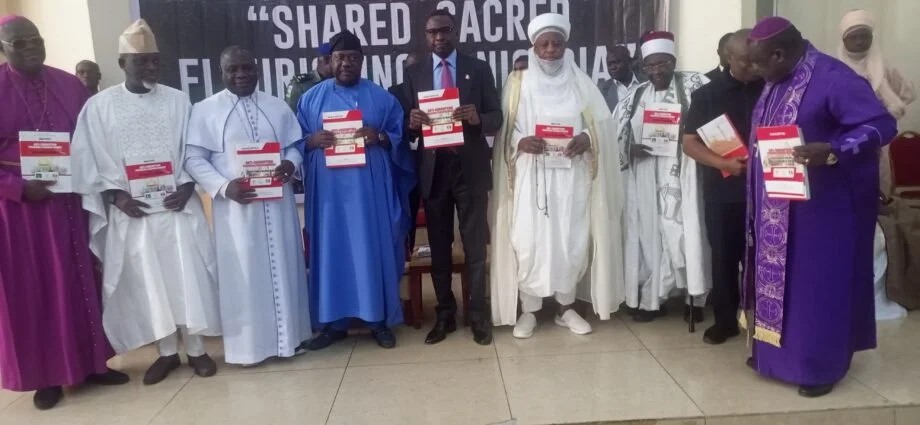
The Chairman of the Economic and Financial Crimes Commission (EFCC), Mr Ola Olukoyede, says corruption remains a profound moral challenge to Nigeria’s quest for shared prosperity.
Olukoyede stated this on Wednesday in Abuja at the Nigeria Inter-Religious Council (NIREC) and unveiling of Inter Faith manual to enlist religious leaders in the fight against corruption.
The News Agency of Nigeria (NAN) reports that the Secretary to the Government of Federation, Sen. George Akume unveiled the manual.
At the meeting themed “Shared Sacred Flourishing in Nigeria,” Olukoyede emphasised that financial crime had no religious or ethnic colouration.
According to him, NIREC exists because Nigeria recognised that its religious diversity needed not become a source of perpetual division.
”Christianity and Islam can retain their distinctive beliefs and traditions while their adherents work together for peace, justice, human dignity and the wellbeing of our nation.
“We are a deeply religious people. Our churches and mosques are full… Yet, we must have the courage to ask ourselves: has the depth of our religious profession been sufficiently reflected in the integrity of our public and economic life?” he asked.
According to him, at first, the EFCC may appear an unusual institution to discuss something described as ‘sacred flourishing’.
”We are a law-enforcement agency… But when we examine the consequences of corruption, fraud and economic crime, we quickly discover that our work touches the very conditions that make human flourishing possible,” Olukoyede said.
He illustrated the human cost of graft, stating.
“When money meant for a hospital is stolen, the offence may be recorded as corruption, but its consequence may be a patient who cannot receive treatment.
“When education funds are diverted, the financial crime becomes a child without opportunity.
”When pension funds are stolen, corruption becomes an elderly Nigerian deprived of dignity after a lifetime of service,” he added.
According to him, corruption privatises what should be shared and allows one person to flourish by making many others poorer, hence the EFCC’s role is to defend the integrity of the commonwealth.
He said to play that role effectively, the EFCC had been engaging religious leaders through its Inter-Faith framework, because “no religion condones corruption and no faith entertains fraudulent engagements.”
Olukoyede announced that the Commission had now designed an Inter-Faith Manual to address topical anti-corruption issues for preaching.
“We are using this opportunity to launch the Manual which we hope our religious leaders will surely find useful in teaching anti-corruption messages to their members.
“The EFCC believes that financial crime has no religion. Corruption has no tribe. Fraud does not become Christian or Muslim because of the identity of the person accused of committing it,” he said.
Driving home the point of shared vulnerability, he declared: “When public money is stolen, both Christians and Muslims suffer. A badly equipped hospital does not first ask a dying patient where he worships.
