










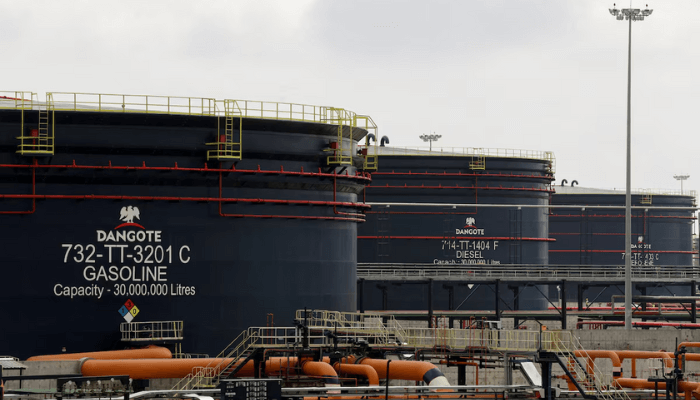
The Managing Director of the Dangote Petroleum Refinery, Mr. David Bird, has clarified that the $20 billion facility is not importing finished petroleum products, explaining that materials brought into the refinery are intermediate feedstocks used for further processing.
Bird made the clarification on Wednesday while addressing journalists at the refinery in Lekki, Lagos, during a technical presentation on its operations.
He explained that the refinery operates a merchant refining model, which allows it to source crude oil and other feedstocks from the global market, rather than relying solely on Nigerian crude.
“Nigeria is a crude-producing country, but Dangote Refinery does not sit on the end of a pipeline just processing the country’s crude oil only. Dangote is a merchant refinery,” Bird said.
According to him, unlike refineries in countries such as Saudi Arabia, Kuwait and the United Arab Emirates, which depend largely on domestic crude supplied via pipelines, the Dangote refinery was deliberately designed to process a wide range of crude oils and intermediate components delivered mainly by sea.
Bird noted that the merchant refining model, commonly used in major refining hubs such as Europe, Singapore and Taiwan, was replicated in Nigeria to maximise operational flexibility and value.
He explained that the refinery’s large tank farm, which is bigger than its processing units, is central to this model as it allows different crude oils and feedstocks to be stored, segregated, blended and processed in varying combinations.
“You bring in different crudes. You need to segregate those crudes, and then you mix them to make certain crude cocktails which your plant can process,” he said.
Bird said each crude oil produces different proportions of products such as LPG, naphtha, kerosene and diesel, adding that without additional feedstocks, some processing units could be underutilised.
He stressed that maximum utilisation of all units is critical in a capital-intensive business like refining.
“It’s all about utilisation. Just like an aeroplane or a hotel, once you build it, you want to drive occupancy. The same principle applies to refining,” he said.
The managing director explained that the major value in refining lies not in crude distillation alone, but in advanced conversion units that upgrade low-value materials into high-value products.
According to him, the refinery converts heavy residues from crude distillation into high-value white products using advanced units such as the Residue Fluidised Catalytic Cracker.
“This is a real moneymaker for us. We crack low-value residue and convert it into high-value white product,” Bird said.
