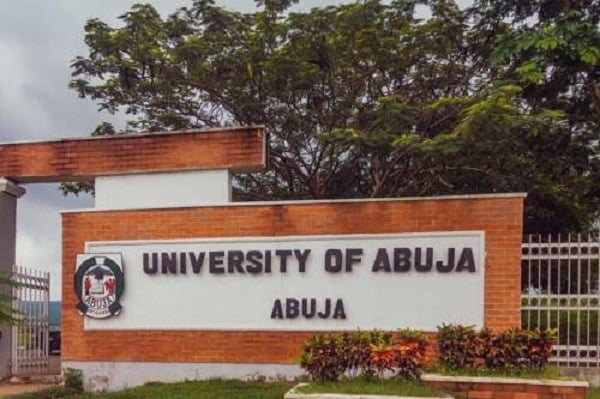
The University of Abuja says 77 graduating students will earn First Class degrees at its combined 29th and 30th convocation ceremonies scheduled for April 17 and April 18, 2026.
The Vice-Chancellor, Prof. Hakeem Fawehinmi, disclosed this on Monday in Abuja during a pre-convocation briefing.
Mr Fawehinmi said a total of 12,624 undergraduate students would graduate from the 2022/2023 and 2023/2024 academic sessions.
He gave a breakdown for the 29th convocation (2022/2023 set) as 48 First Class, 2,048 Second Class Upper, 4,418 Second Class Lower, and 644 Third Class, totalling 7,158 students.
For the 30th convocation (2023/2024 set), he said 29 students made First Class, 1,395 Second Class Upper, 3,091 Second Class Lower, and 951 Third Class, bringing the total to 5,466 graduates.
“We are indeed very proud of our graduands who we have trained not only in knowledge and skills but also in character.
“As part of our commitment to the development and advancement of our graduates, the overall best graduating students of both sets will be given automatic employment in the university to further their career,” he said.
Mr Fawehinmi added that the ceremonies would hold on April 17 for first degrees and April 18 for higher degrees and honorary doctorate awards.
He said the institution would confer honorary doctorate degrees on distinguished Nigerians, including Prof. Yusuff Ali (SAN), Mr Paul Odili and Mr Emmanuel Iza, in recognition of their contributions to society.
The vice-chancellor said the university, established in 1988, currently has nearly 40,000 students, with projections to reach 50,000 by 2030.
“With this increase, the institution needs massive expansion of infrastructure to become a modern university of first choice,” he said.
He noted that the university had secured research grants from TETFund and other partners, including a N4 billion intervention for the College of Health Sciences.
According to him, the institution also hosts a Centre for Sickle Cell Disease Research and Training, which has driven key interventions across Nigeria and sub-Saharan Africa.
On infrastructure, Mr Fawehinmi said the university was undertaking a 1,500-bed student accommodation project through a public-private partnership with Royal Dynasty Homes Ltd.
He added that the university had also partnered with Plan International Nigeria to advance education, gender inclusion and institutional development.
Mr Fawehinmi said students of the university had been invited by the British Council to participate in a workshop on the use of Artificial Intelligence for weather prediction and climate change, with a £20,000 grant opportunity for selected participants.
Speaking on staff and student welfare, he said over 100 academic staff had recently been promoted to professorial rank, while recruitment and training continued.
He added that the university was engaging with the Nigeria Social Insurance Trust Fund on employee compensation schemes and had improved student welfare through better accommodation, healthcare and campus security.
Mr Fawehinmi disclosed that the university senate had approved the expulsion of 28 students for offences ranging from examination malpractice to drug possession.
“Our campus is designed for those who are disciplined enough to advance the course of learning,” he said.
He, however, identified funding constraints and land encroachment as major challenges facing the institution.
“Funding remains a challenge, even though we cannot rely on the government entirely as we continue to strengthen our internally generated revenue and block leakages.
“Encroachment on university land from all fronts is also a serious challenge,” he said. (NAN)