Nigeria Christian Pilgrims Commission (NCPC) has disclosed that more than 40,000 Nigerians have been transported to the Holy Land since the current Executive Secretary, Stephen Adegbite, assumed office two years ago.
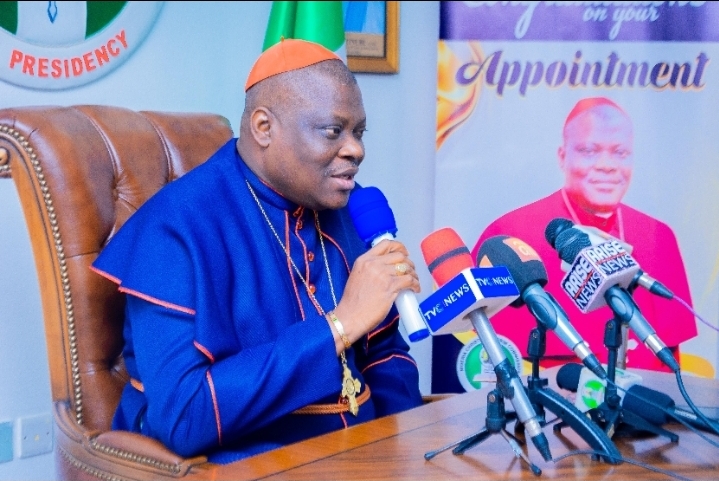
Adegbite, who spoke to journalists on Wednesday in Abuja to mark his second anniversary in office, described the feat as a testament to faith, improved administration and government support.
According to him, no pilgrimage year under his leadership recorded fewer than 20,000 pilgrims, including those sponsored by government.
“We have conducted five operations since I came. We had the first main pilgrimage.
We had the Executive one, Executive two, then we have the Easter pilgrimage, and we have this current main pilgrimage for 2025 that is ongoing.
We will conclude by March next month.”
He said the commission deployed wide-body aircraft for the first time in Nigerian Christian pilgrimage history.
“We brought the biggest aircraft to Nigeria for the first time. We brought Boeing 777 that carries 525, and then the second time, we brought another one that carries 550 at once.”
Adegbite said the 2025 pilgrimage set new benchmarks in airlift operations and organisation.
“For the first time, we brought a Boeing 777 to Nigeria with a capacity of 525 pilgrims, and we thought that was the peak.
Then we brought another aircraft that carries 550 passengers at once. It shows the scale and organisation we have achieved.”
Responding to criticisms that government support for pilgrimage amounted to wasteful spending, Adegbite argued that spiritual investment yielded national benefits.
“Anybody saying pilgrimage is a waste of money does not understand scripture.
Prayer is the sustaining grace we have as a nation; when pilgrims go to the Holy Land, they pray daily for Nigeria.”
He added that the commission would continue to seek the support of Bola Tinubu, whom he praised for supporting both Christian and Muslim pilgrimages.
“We pray that the amount people will be paying for pilgrimage will not increase so that more people go on Holy Pilgrimage.”
On the issue of abscondment—where pilgrims fail to return after pilgrimage—Adegbite acknowledged it could not be totally eliminated but said it had been drastically reduced.
“For instance, if 550 people travel and only two abscond, we must give glory to God. That is a significant reduction compared to what we used to have.”
He attributed the improvement to new administrative and orientation measures, better staff discipline and enhanced security.
Adegbite also disclosed reforms in the selection of medical personnel for pilgrimages, noting that experience and performance now outweigh paper qualifications.
“In the past, some medical personnel saw pilgrimage as a fashion parade. Now we select based on competence and feedback.
If someone performs exceptionally, we bring them back.”
He said Nigeria remained the leading African nation in pilgrimages to Israel, a position affirmed by other countries at a continental forum in Kenya, adding that some African leaders were seeking collaboration with Nigeria to strengthen their own programmes.
Beyond pilgrimage operations, Adegbite said his administration was focused on completing the commission’s heritage building project and exploring the acquisition of property in the Holy Land to support Nigerian pilgrims during emergencies.
“It is my desire that before I leave office, the heritage building will be completed and inaugurated as a legacy project.”
He added that staff welfare had improved, revealing that all 180 staff members of the commission had travelled at least twice since he assumed office.
Adegbite expressed gratitude to President Tinubu and the First Lady, Oluremi Tinubu, for the opportunity to serve, describing the commission’s transformation over the past two years as a shift “from disgrace to grace.”
“As long as there is life, there is hope, vision and mission, and for us at the NCPC, pilgrimage remains a divine assignment and a national blessing.”
(NAN)