










By Vitus Ozoke, PhD
If politics were only local, Bola Ahmed Tinubu’s path to 2027 would be determined almost entirely by domestic manoeuvring, party discipline, and the blunt advantage of incumbency. But politics is no longer merely local—if it ever was. In today’s world, power is exercised as much through perception and narrative as through ballots and institutions. And it is on this terrain that Bola Tinubu faces his most serious vulnerability. He has governed Nigeria as if global power dynamics stopped evolving sometime in the early 2000s. That illusion may soon cost him not only legitimacy, but his political future.
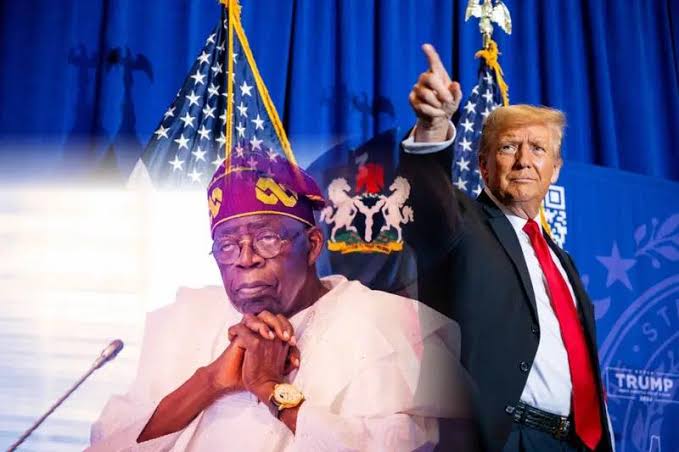
So let me be direct: Washington will not allow Bola Tinubu to run for president again in the 2027 Nigerian election. Let me translate that into Nigerian pidgin: Baba, abi na Uncle Donald Trump and the United States no go tolerate Baba Tinubu pass 2027. Not quietly. Not politely. And certainly not out of respect for Nigeria’s electoral process. If Tinubu is truly as shrewd and politically discerning as his admirers insist, he should already see the storm gathering on the horizon—and understand that it is not one he can outmanoeuvre with the usual tricks of incumbency. The geopolitical weather has changed.
The international framing of Nigeria’s insecurity is shifting in ways that should alarm even the most confident strategist in Aso Rock. Recent U.S. military actions and policy rhetoric increasingly situate violence in parts of Africa within a simplified schema: Islamist extremism versus Christian victimhood. While analytically crude, this framing is politically potent, especially within American evangelical and conservative ecosystems that exert outsized influence on Republican foreign policy.
The moment American airstrikes entered the African theatre and Nigeria’s insecurity was deliberately reframed as Islamic terror against Christian populations, Tinubu’s fate was effectively sealed. That framing is not accidental; it is ideological ammunition. It is certainly not favourable to Bola Tinubu, whose political identity is inseparable from a Muslim-Muslim ticket. It plays directly into the ideological instincts of a Trump White House and feeds the bloodstream of Trumpism, where evangelical politics is indistinguishable from national security doctrine.
Donald Trump’s America does not hide its messianic pretence. Evangelical politics is not a sideshow; it is a governing force. This is not conventional foreign policy; it is crusade politics. Trump does not view the world through diplomatic nuance. His foreign policy record shows little patience for complexity. Context is irrelevant. His worldview collapses intricate internal conflicts into moral binaries aligned neatly with domestic political constituencies. Trump sees enemies, symbols, and narratives. Africa, especially, is filtered through a worldview that divides the globe into persecuted Christians and suspect Muslims.
Within such a framework, Nigeria is being recast not as a multi-religious state struggling with governance failures, but as a symbolic battleground in a broader civilisational story. In that worldview, a Muslim-Muslim ticket presiding over a country portrayed as a graveyard of Christians is not a governing arrangement—it is an indictment.
Nigeria’s current leadership configuration was defended domestically as pragmatic and constitutional. Internationally, however, symbolism often outweighs explanation. Once Nigeria is viewed through the lens of religious conflict, that ticket ceases to look like political arithmetic and begins to resemble ideological imbalance. Whether this perception is fair is irrelevant; what matters is that it travels easily in Washington’s policy bloodstream. And Washington, particularly under Trump, governs by perception.
The APC sold Nigerians an experiment in convoluted political pragmatism: religious homogeneity at the top in exchange for “competence.” What it failed to calculate was how radioactive that choice would become once Nigeria was dragged into America’s culture war. To the American evangelical establishment, a Muslim-Muslim ticket is not inclusivity; it is confirmation. It is not balance; it is bias. And it is certainly not optically attractive.
American evangelicals—who consume politics through television soundbites—do not negotiate with optics. They absorb them. And the optics are catastrophically brutal for Bola Tinubu. They see a leader whose electoral victory was contested at home, now presiding over a country increasingly portrayed abroad as a killing field where Christian communities are under siege. In Washington’s evangelical echo chamber, this is not about land disputes, state failure, or criminal banditry. It is about religion. Once that frame hardens, no amount of diplomatic finesse can soften it.
Sovereignty does not survive when global power decides you are a liability.
