










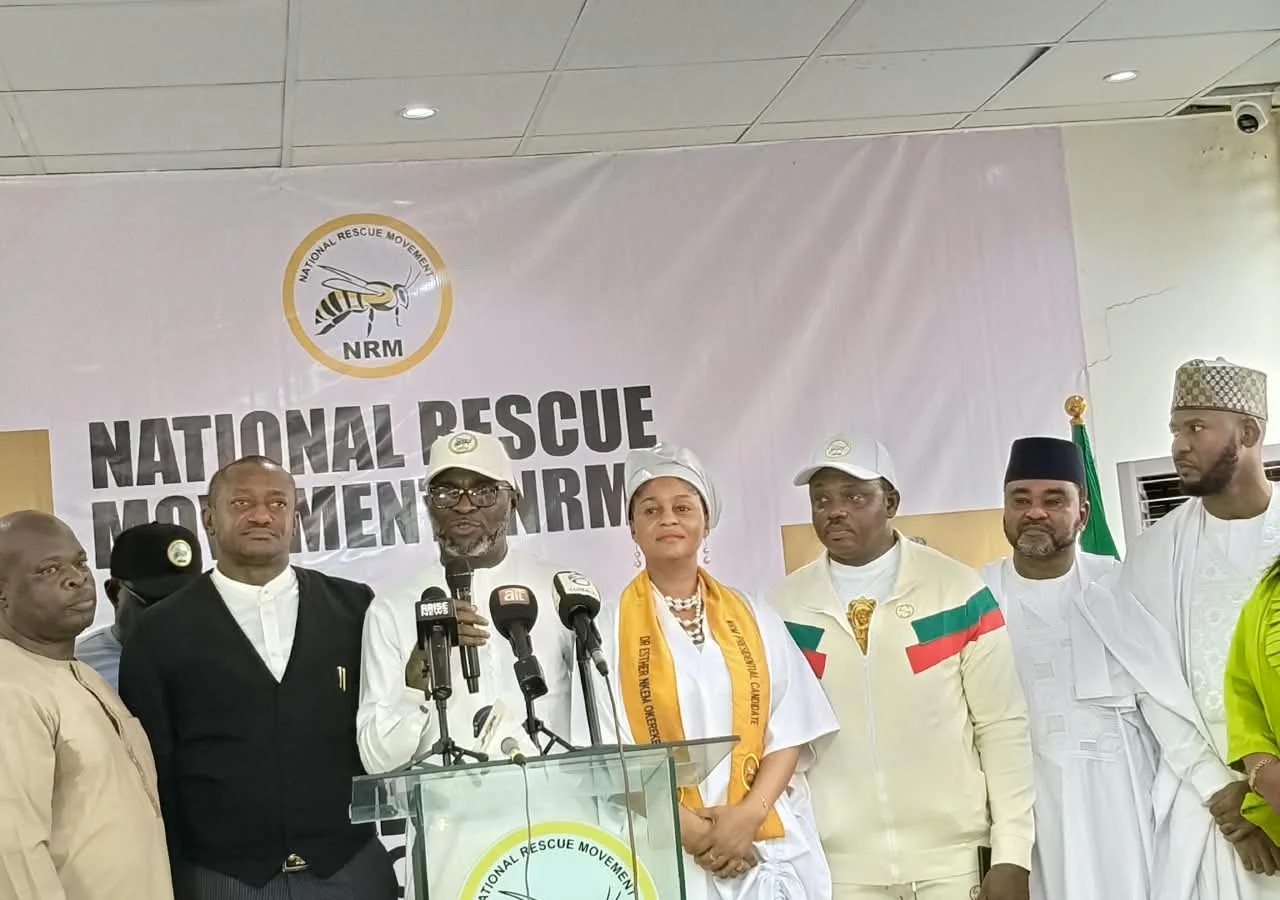
The National Rescue Movement (NRM) has inaugurated a 38-member Presidential Campaign Council for the 2027 general elections with Muhammad Garba as the Director-General of the council.
The News Agency of Nigeria (NAN) reports that Dr Esther Okereke, the NRM presidential with Nasir Muhammed as running mate and Mrs Ada Okwori, the presidential candidate of National Democratic Party (NDP), are the two female presidential candidates for the 2027 elections.
NRM National Chairman, Prince Chinedu Obi who performed the inauguration on Tuesday in Abuja, described the ceremony as the formal rollout of a fundamental proposition that “Nigeria can work again” through institutional reforms.
Obi said that Nigeria possessed extraordinary advantages including a large, youthful population, vast agricultural potential, natural resources and entrepreneurial citizens, to achieve sustainable growth.
He said the NRM believed that converting those advantages into broad-based prosperity requires functional institutions, leadership systems, processes and accountability mechanisms.
“Our governing philosophy is anchored on the rule of law for peace, productivity and shared prosperity.
“The rule of law is the operating system of a functional state where the law is predictable, citizens can plan, businesses can invest, contracts are enforceable and public officials are accountable,” Obi said.
The national chairman also unveiled the “NRM policy engagement for a new Nigeria’’ centered around six principal pillars, which he described as the “Esther Rescue Nigeria Agenda.’’
Obi said that the pillars which were summarised in the 24 pillars of the NRM blueprint provided a framework for addressing major areas of Nigeria’s developmental deficit.
He listed the policy focus areas to include; strengthening public-sector accountability, enforcing due process, improving transparency and setting measurable performance standards across government.
He said that the policy also focused on productive economy and employment, human capital development through prioritising quality education geared toward technical competence; accessible, affordable and preventive healthcare.
Others pillars according to him were security, justice and national cohesion; delivering reliable power, modern transportation, housing and digital connectivity integrated with environmental sustainability.
“The sixth pillar situates that the Nigeria of the future cannot be built exclusively around the economic structures of the past.
We must develop the capacity to compete in a global knowledge economy.
“That requires investment in science, technology, research, innovation, digital infrastructure, technical and vocational education and entrepreneurship,’’ he said.
